Impact of Taxes
How Account Type Affects What You Actually Get to Spend
In retirement, what matters most isn't gross income—it's after-tax, spendable income. Two retirees can receive the same Social Security and withdraw the same dollar amount from their accounts, yet end up with very different amounts to spend, depending on where those dollars come from.
Assumptions for this example:
Married couple filing jointly
$40,000 per year in Social Security benefits
$60,000 per year of additional income needed
Standard deduction assumed
Federal taxes only (state taxes excluded)
Tax rates approximated for illustration
Scenario A: Traditional IRA + Social Security
Income sources:
$60,000 Traditional IRA withdrawal (taxable)
$40,000 Social Security benefits
Provisional Income Calculation:
$60,000 IRA withdrawal
+ $20,000 (½ of Social Security)
= $80,000 provisional income
At this level, up to 85% of Social Security becomes taxable.
Approximate Tax Impact:
Taxable Social Security ~$34,000
Total taxable income: ~$94,000
Less standard deduction: (~$32,200)
Taxable income: ~$61,800
Estimated federal taxes: ~$7,700–$8,600.
Net Spendable Income:
Gross income $100,000
Less taxes ~$8,100
Net Spendable: ~$91,900
Scenario B: Roth IRA + Social Security
Income sources:
$60,000 Roth IRA withdrawal (tax-free)
$40,000 Social Security benefits
Provisional Income Calculation:
$0 taxable withdrawals
+ $20,000 (½ of Social Security)
= $20,000 provisional income
At this level, Social Security is NOT taxable.
Approximate Tax Impact:
Taxable income: ~$0
Estimated federal taxes: ~$0
Net Spendable Income:
Gross income $100,000
Less taxes: ~$0
Net Spendable: ~$100,000
The Side-by-Side Difference
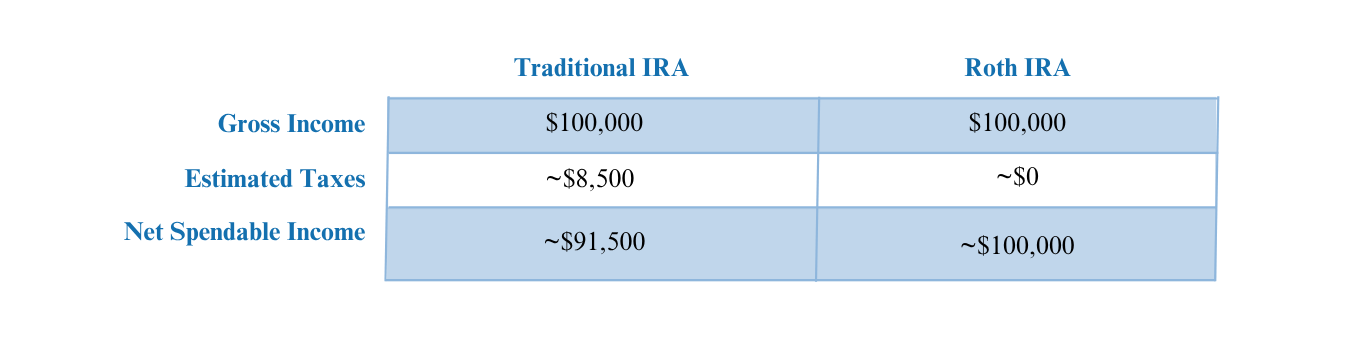
That gap works out to roughly $8,100 per year, ~$81,000 over 10 years, and ~$162,000 over 20 years (before inflation).
Same gross withdrawals. Very different outcomes.
Key Insight
Pre-tax withdrawals don't just create taxes—they can trigger additional taxes on Social Security.
Roth withdrawals provide control:
over taxable income,
over Social Security taxation,
and over long-term planning flexibility.
Our Approach
We focus on balancing pre-tax, tax-exempt, and Roth assets, coordinating withdrawals intentionally, and reducing taxes that don't need to be paid.
The goal isn't to eliminate taxes—it's to avoid avoidable taxes.
This is for educational purposes only.