Roth withdrawals & 0% capital gains
Coordinating Income Sources to Maximize What You Keep
In retirement, the goal isn't to withdraw the most money—it's to withdraw money in a way that minimizes taxes while supporting your lifestyle. One of the most powerful (and overlooked) strategies involves coordinating Roth withdrawals, long-term capital gains, and Social Security benefits.
Key Concepts
Roth withdrawals do not increase taxable income.
Long-term capital gains can be taxed at 0% if taxable income stays below certain thresholds.
Social Security taxation depends on provisional income, which Roth withdrawals do not increase.
Used together, these rules can allow retirees to take meaningful income with little or no federal tax.
Assumptions for This Illustration
Married couple filing jointly
$40,000 per year in Social Security benefits
Federal taxes only (state taxes excluded)
Rounded numbers for illustration
Portfolio includes a Roth IRA / Roth 401(k) and a taxable brokerage account with long-term gains
Step 1: Start With Social Security
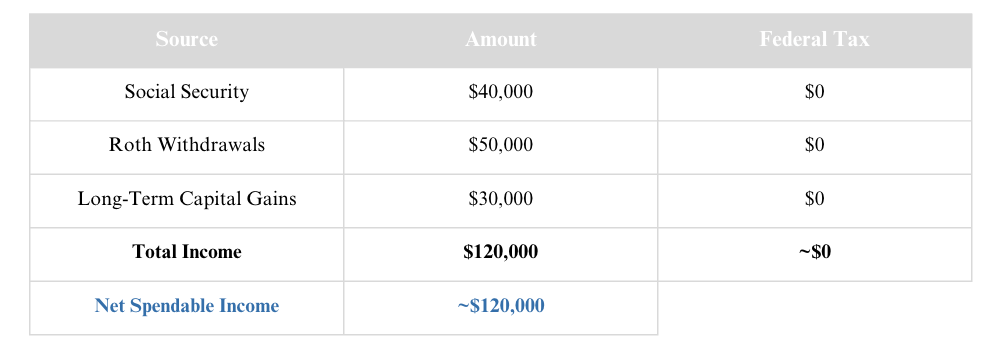
Annual Social Security: $40,000
Half counted toward provisional income: $20,000
At this level alone:
Social Security is not taxable
Taxable income is still very low.
Step 2: Use Roth Withdrawals for Core Spending
Assume a $50,000 Roth withdrawal.
Because Roth withdrawals are not taxable and do not count toward provisional income, taxable income remains unchanged.
At this point:
Spendable income = $90,000
Federal tax bill ≈ $0
Step 3: Layer in Long-Term Capital Gains at 0%
Now assume the couple needs additional income and sells assets from a taxable account: $30,000 in long-term capital gains.
Because taxable income is still low:
These gains fall into the 0% long-term capital gains bracket
Federal tax on the gains ≈ $0
Total Annual Retirement Income
Compare That to a Pre-Tax Withdrawal Approach
If instead the couple withdrew:
$80,000 from a traditional IRA
They would likely:
Increase provisional income,
Cause up to 85% of Social Security to be taxable,
Lose access to the 0% capital gains bracket,
and Generate a meaningful tax bill. Same lifestyle.
Same portfolio value. Very different outcomes.
Why This Strategy Works
This approach:
Preserves low taxable income,
Protects Social Security from taxation,
Allows harvesting gains at favorable rates, a
and Increases long-term planning flexibility.
The power isn't in any single account—it's in how the accounts work together.
Our Approach
We focus on building tax-diversified portfolios, coordinating withdrawals across account types, and intentionally managing income to reduce unnecessary taxes. The goal isn't aggressive tax avoidance—it's efficient income design.
What This Means for You
With the right structure, retirees can often spend more, pay less in taxes, and preserve flexibility for later years.
Smart retirement income planning isn't about guessing markets—it's about understanding the rules and using them thoughtfully.
This is for educational purpose not financial advice.